Skin status
Needling and wet cupping require sterile invasive-item and sharps questions; dry cupping does not intentionally pierce skin.
Needle and suction guide
The biggest practical difference is whether skin is penetrated. That changes consent, equipment and aftercare questions.
Quick answer
Dry needling uses needles through the skin; dry cupping uses suction without intentional incisions. Wet cupping adds skin breaks too.
Ask who will provide the method, what training applies, which risks are relevant and how the plan fits any existing diagnosis or rehabilitation. Do not turn either method into a trigger-point or detox promise.
Bleeding, infection, severe pain or neurological symptoms need appropriate care—not a choice between two labels.
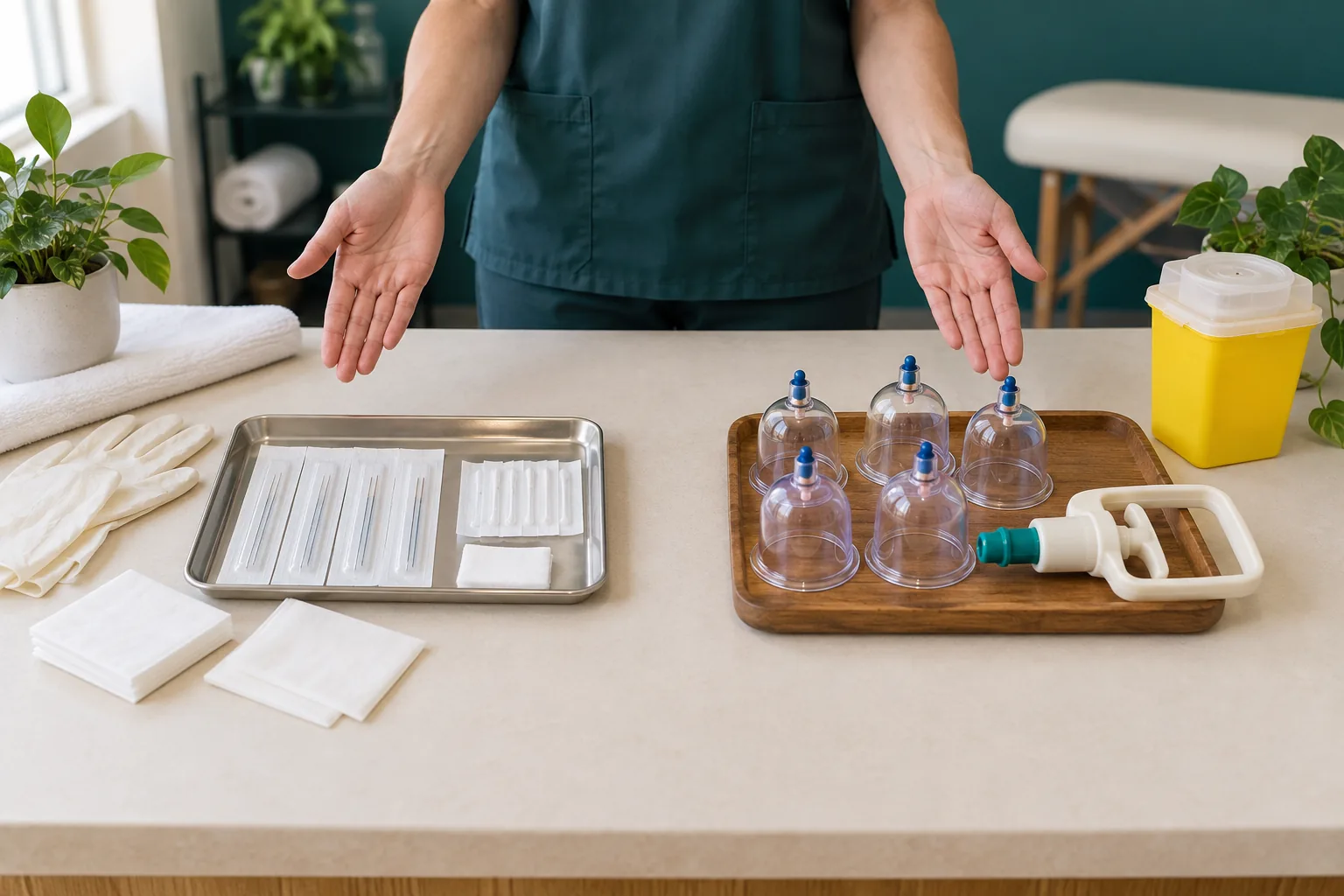
Dry needling and cupping are sometimes grouped together because both may be discussed for muscle discomfort, but the procedures are materially different. Dry needling places a needle through the skin. Dry cupping creates suction without intentionally piercing skin. Wet cupping also involves skin breaks and blood contact, so it shares some invasive-procedure questions even though the technique is not needling. Before comparing benefits, clarify the exact method and whether the skin remains intact.
This distinction changes the consent conversation, supplies, infection-control controls, possible bleeding and aftercare. It does not create a simple ranking in which one method is always safer. Suitability depends on the person, body area, reason for the enquiry, provider scope and how the procedure is controlled. Neither a needle response nor a cup mark diagnoses the source of pain, releases a proven “trigger point,” removes toxins or demonstrates that healing has occurred.
For dry needling, ask how many needles may be used, the proposed body area, expected depth or approach, whether needles are manipulated, how long they remain, and what training and professional scope apply. Do not infer competence from the word dry, which only distinguishes the method from injecting a substance. Ask what finding led to the plan and whether a medical or physiotherapy assessment is needed first.
For cupping, ask whether the proposal is dry or wet, what cup material and suction method are used, how pressure and duration are controlled, and whether cups remain stationary or move across the skin. NCCIH defines dry cupping as suction without piercing and wet cupping as piercing the skin so blood enters the cup. That official distinction is more useful than a vague promise of “deep release.” If the provider changes from dry to wet cupping, it is a new consent decision with additional controls.
| Decision area | Dry needling | Dry cupping | Wet cupping |
|---|---|---|---|
| Skin | Needle penetrates skin | No intentional skin break | Skin is intentionally broken |
| Key supplies | Sterile single-use needles and sharps container | Clean cups and suction controls | Sterile single-use invasive items, cups and sharps controls |
| Visible response | Small puncture sites may need observation | Suction marks or tenderness may occur | Marks plus wound and bleeding aftercare |
| Stop signal | Unexpected sharp, electrical or severe pain | Painful pinching, burning or intolerance | Those concerns plus bleeding or wound concerns |
The table is not a procedure manual. It shows why you need a method-specific explanation. Photos of a bent needle, dark circle or drop of blood do not tell you whether a procedure was indicated, sterile, controlled or helpful.
Describe the symptom, its onset, recent changes and any medical or rehabilitation advice already received. Tell the provider about medicines that affect bleeding, a bleeding disorder, poor wound healing, diabetes or another condition relevant to healing, pregnancy, allergy or sensitivity to skin products, active infection, rash, broken skin, recent surgery and altered sensation. Do not stop an anticoagulant, antiplatelet or any other prescribed medicine to make an invasive appointment possible; ask the prescribing clinician for advice.
Clarify the body area and privacy plan. A provider should explain what clothing needs to move, how draping works and who will be in the room. Ask whether a companion or chaperone can attend. Consent is specific: agreeing to an examination does not approve needling, and agreeing to dry cupping does not approve wet cupping. You can exclude an area or withdraw consent at any stage.
CDC Standard Precautions apply to all patient care and are based on risk assessment. They include hand hygiene, personal protective equipment when exposure to infectious material is expected, safe handling of equipment, appropriate cleaning and disinfection of the environment, safe injection practices and proper sharps handling. Use those principles to ask visible, practical questions rather than accepting “everything is sterile” as a slogan.
NCCIH warns that cups can be contaminated with blood during wet cupping and even inadvertently during dry cupping, and that reuse without sterilisation can spread bloodborne infections. Gloves alone do not solve that problem. The workflow for equipment and surfaces matters.
Before starting, agree on an ordinary word or hand signal that stops the procedure. With needling, ask what sensations the practitioner expects and report severe, electrical, spreading or otherwise unexpected pain, dizziness, faintness, breathlessness or distress. With cupping, report burning, sharp pinching, rapidly increasing pain, numbness or a feeling that the cup cannot be tolerated. No one should tell you that suffering is necessary for success.
If the plan changes—more needles, another body area, wet instead of dry cupping, added heat or another device—the provider should stop and seek new consent. You should not discover the change through sensation. A practitioner should also stop to reassess if bleeding is more than expected, skin changes rapidly, or equipment integrity is uncertain.
After dry cupping, ask how to care for temporary marks or tenderness, what products to avoid on irritated skin and when clothing friction, exercise or water exposure can return to normal. NCCIH notes that temporary marks are expected but also lists persistent discoloration, scars, burns, infection and worsening of eczema or psoriasis among possible adverse effects. A dark mark is not a diagnostic chart or evidence of toxin removal.
After needling or wet cupping, obtain a wound-care plan. NHS guidance for small cuts emphasises hand hygiene, stopping bleeding, cleaning with water or sterile wipes, drying with clean material and covering with a sterile dressing. Follow the provider’s specific instructions for the procedure and seek appropriate advice if bleeding continues or the wound is concerning. Keep dressings clean and dry as directed; do not add oils, powders or home remedies to puncture sites unless appropriate clinical advice supports them.
NHS wound guidance advises urgent help when a wound remains dirty, becomes swollen, red and increasingly painful, produces pus, or is accompanied by feeling unwell or a high temperature. Seek urgent care for uncontrolled bleeding, serious injury or another severe reaction. New weakness, numbness, loss of function, significant trauma, chest symptoms or rapidly worsening pain also belong in appropriate medical assessment rather than a follow-up complementary session.
If you feel faint during an invasive procedure, say so immediately and do not stand suddenly. If symptoms persist after you leave, use appropriate local medical services. Reporting the event to the clinic is important for its records, but it should not delay care.
NCCIH says most cupping research is low quality, evidence for pain reduction is not strong, and there is not enough high-quality research to conclude whether it helps other conditions. That does not answer every question about dry needling, and evidence about needling should not be used to advertise cupping. Ask for evidence that matches the exact method, condition, population and outcome. A study of short-term pain is not proof of tissue repair, and an anecdote cannot establish cause.
Choose one modest outcome and a review date. Keep prescribed rehabilitation and medicine unchanged. Record adverse effects, recovery time and the practical burden of aftercare as well as any perceived benefit. If the goal is unclear or the method adds risk without a meaningful reason, declining is a valid decision.
A responsible comparison may lead to one method, neither method or a referral first. The purpose of these questions is not to direct treatment; it is to make the decision transparent enough for informed consent.
Key takeaways
Needling and wet cupping require sterile invasive-item and sharps questions; dry cupping does not intentionally pierce skin.
Needle insertion, suction, tenderness and marks should be described before consent.
Neither method guarantees a cure or replaces diagnosis.
Bleeding, infection, severe pain or neurological symptoms need appropriate care—not a choice between two labels.
This editorial guide is general education. It does not diagnose a condition, confirm suitability or promise a clinical result.
Practical checklist
Appointment enquiry
Ask for the exact method, practitioner scope, invasive-item controls and aftercare before choosing.

Continue learning
Compare the exact method, read the safety framework and return to the Insights hub before you enquire.
Frequently asked
No. Needling penetrates the skin; dry cupping uses suction without intentional incisions.
Safety depends on the person, method, practitioner, screening and controls.
No. Keep prescribed assessment and rehabilitation central.